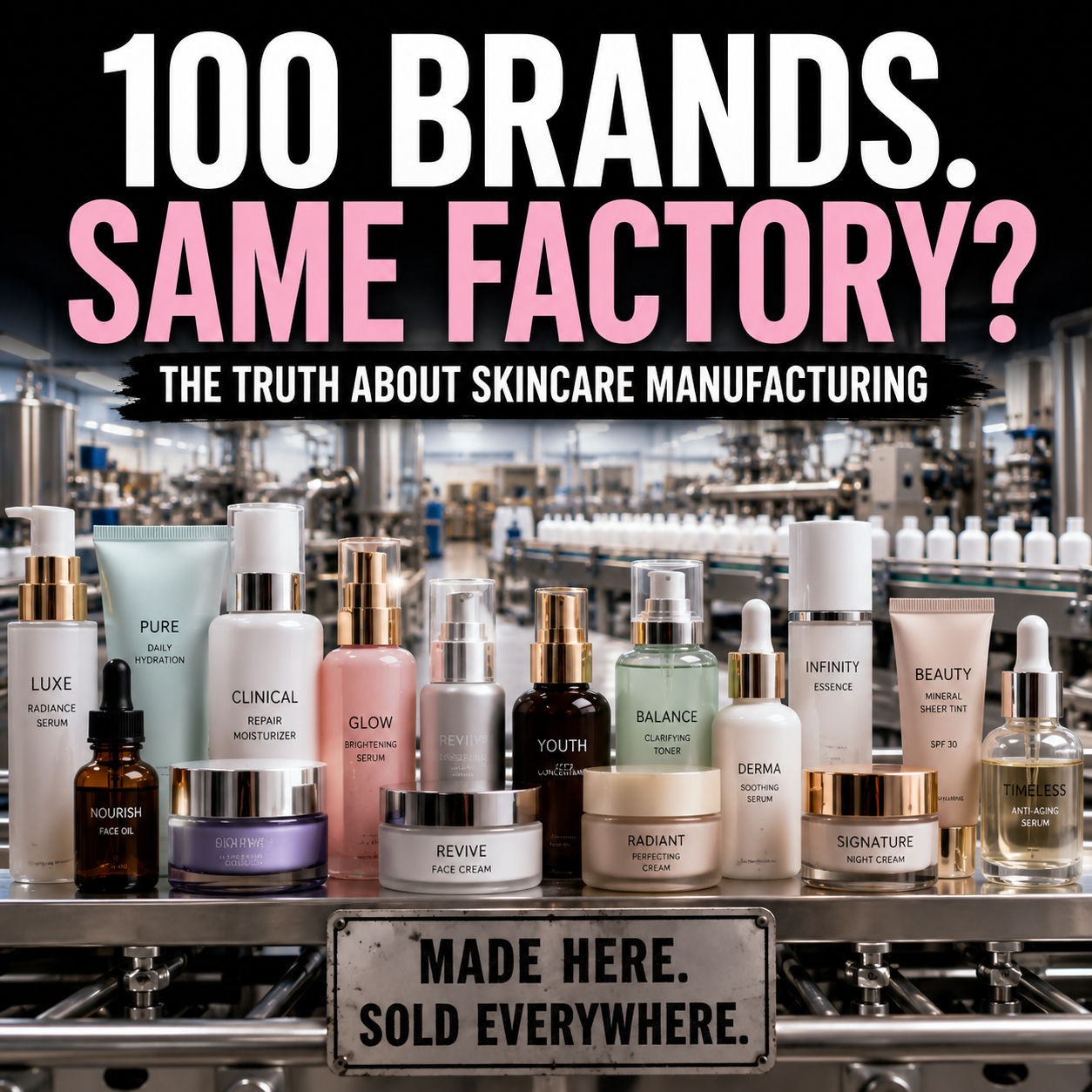
Who Really Makes Your Skincare? The Truth About Private-Label and Luxury Skincare Brands
Walk through Sephora or Ulta. Look at the skincare counter at Saks, Neiman Marcus or any department store. Then look at the products sitting in your dermatologist’s office or at your aesthetician’s spa.
You see hundreds of brands. Different founders. Different bottles. Different promises. Celebrity skincare, dermatologist skincare, clinical skincare, luxury skincare. A serum for $48 sitting twenty feet away from another serum for $180.
It certainly looks like hundreds of companies created hundreds of completely different skincare formulations.
That is not how much of the beauty industry works.
A relatively small group of enormous contract manufacturers develops and produces products for an astonishing number of brands. KDC/One says it serves 1,000 different brand names and co-develops approximately 3,000 products every year. It handles everything from ideation and formulation to manufacturing and packaging.
COSMAX is even larger. The company says it supplies around 1,300 brands in approximately 100 countries. More than 90% of its sales come from ODM manufacturing. ODM means the manufacturer does considerably more than fill a bottle with a formula supplied by the brand. COSMAX researches and develops products itself, proposes those products or concepts to clients, manufactures them and delivers the finished product.
Then there is Intercos, one of the largest outsourced beauty manufacturers in the world. It reports more than 700 customers, including multinational companies, emerging brands and retailers, and says its client base includes almost all of the major players in the cosmetics industry. It also describes itself as the leading Western company by sales in outsourced skincare.
Now look at that skincare wall again.
Suddenly, 200 brands do not necessarily represent 200 independent laboratories inventing products from scratch.
This becomes even more interesting when you look at private-label manufacturing.
There are U.S. manufacturers openly offering hundreds of completed formulations ready for someone’s brand name. Trilogy Laboratories markets more than 554 ready-to-brand formulations directly to beauty brands, med spas, dermatologists, plastic surgeons and estheticians. Another U.S. manufacturer advertises more than 500 proven formulas. Others offer libraries containing 1,000 or even 2,000 stock formulations.
There is nothing illegal or inherently wrong with that.
It is simply something consumers rarely think about.
A company can choose an existing cleanser, serum or moisturizer, make certain changes, select packaging, create a name and build a beautiful marketing story around it. The person whose name appears on the bottle does not necessarily have a laboratory. The dermatologist selling a branded serum may not have developed that serum. Your aesthetician’s “exclusive” skincare line may come from a manufacturer offering hundreds of other formulations to other businesses.
And a celebrity certainly does not need to spend years standing beside cosmetic chemists developing a formula from the first ingredient forward.
Price does not answer the question either.
Manufacturing at scale has its own priorities. A product has to meet a target cost. Ingredients need reliable availability. Production needs to work in enormous batches. The formula needs sufficient stability and shelf life. Texture, fragrance, packaging and the marketing story all matter because the finished product still has to sell.
That business model makes perfect sense.
It just isn't how we create skincare at Sokörpe Laboratories.
We don't start by asking what formula is already available for us to put into a Sokörpe bottle.
We start with the skin.
What are we trying to accomplish? Which actives make sense? At what concentrations? Which ingredients work together? What belongs in the formulation, and just as importantly, what doesn't?
Then we create the formulation.
That is a much harder way to build a skincare company. It takes more time. It requires research, testing and continual refinement. It also gives us something far more valuable than another product to place on a shelf.
It gives us control over what is inside the bottle.
The next time you stand in front of 100 beautiful skincare products, forget the celebrity for a moment. Forget the gold cap, the clinical-looking box and the photograph of the dermatologist.
Ask one simple question:
Who actually created what I am about to put on my skin?
You may be surprised by the answer.
Written by Alexander Brosda | IHWS
Integrative Holistic Wellness Strategist
CEO – Sokörpe Laboratories
Skincare formulation researcher and skincare science educator.
Helping people optimize appearance, energy, resilience, mindset, and lifestyle.